
2026/04/13 21:50
When a kintsugi piece is being repaired, there is a moment near the end of the process — after weeks of lacquer work — when the craftsperson has to decide what colour to finish in. Gold is the classic answer. But it is not the only one, and it is not always the right one. Here is what the different options actually look like, and how to think about which suits a given piece. 1. Gold (金粉) 2. Silver (銀粉) 3. Platinum (白金粉) 4. Black urushi and bengara 5. Gold powder grades 6. Frequently Asked Questions Gold is warm. It pulls toward the eye, sits forward in the composition, and catches light in a way that makes a repair feel celebratory rather than apologetic. On a pale celadon glaze, on cream-white majolica, on the grey-blue of a weathered stoneware — gold reads as a clear declaration: this happened, and it was worth attending to. It is also the most legible finish from a distance. A kintsugi piece finished in gold can be understood from across a room. The repair is not subtle. For most ceramics, gold is the right default. The warmth of 23-karat maki-e powder (蒔絵粉) against the cool tones of most glazes creates a contrast that feels resolved rather than jarring — as if the gold belongs to the ceramic, not just to the repair. Silver is cooler and more understated than gold, which makes it a better choice for pieces with warm or earthy glazes where gold might compete rather than complement. Against a terracotta red, a deep ochre, or a celadon that runs toward green, silver reads quietly and well. There is one important thing to know about silver, though: it tarnishes. Not in a way that is permanent or ugly — the darkening that silver develops over years of handling is considered part of its character, and many people find aged silver kintsugi more beautiful than it was when new. But it does mean the finish changes, which not everyone wants. Silver is also less visible from a distance than gold. On some pieces this is exactly the point — a repair you notice gradually, rather than one that announces itself immediately. Platinum sits between silver and gold — cooler than gold, but with less tendency to tarnish than silver. The finish is more subdued than either, with a quality that people often describe as silvery without the silver's warmth shift over time. It suits pieces where you want a metallic finish that will stay consistent — where the permanence of the look matters as much as the look itself. Platinum repairs tend to read as precise and considered rather than exuberant. For a very fine piece of porcelain, or for a crack that runs through a delicate painted motif, platinum can be the most respectful choice. Not every kintsugi finish is metallic. Black urushi (呂色漆) left as the final coat produces a line that is dark, matte, and architectural — more like a drawing than a repair. On the right piece, especially one with a very busy or colourful glaze, a black finish can be the most coherent choice, tying the work to the ceramic's own tonality rather than introducing a new element. Bengara (弁柄) — the iron oxide red used as the base layer before gold is applied — can also be used as a finish in its own right, producing a vermilion-red line rather than a metallic one. It is unusual but striking, and has deep historical resonance: bengara lacquer was used in Japanese craftwork long before gold powder was developed. On the right piece — something with a red or deep orange glaze, or a piece from a tradition where red lacquer already has meaning — a bengara finish can feel genuinely surprising and right. Within gold itself, there are further choices. The three main grades used in honkintsugi (本金継ぎ) are keshi-fun (消粉), nobe-fun (延粉), and maru-fun (丸粉) — fine, medium, and coarse particle sizes respectively. Keshi-fun produces the finest, most even finish and requires no post-application polishing. Maru-fun, with its larger particles, creates a surface with more visible texture and depth — light catches it differently depending on the angle. The choice between them is partly aesthetic and partly practical: maru-fun requires a process called fun-gatame (粉固め) to fix the powder, and the result has a quality that rewards very close looking. For most pieces, keshi-fun is the right default. The finish is clean, consistent, and food-safe once the lacquer beneath it has fully cured. No, provided the repair uses genuine urushi lacquer throughout and the piece is fully cured before use. The food safety of a honkintsugi piece depends on the urushi and the curing process, not on which metallic powder is used at the final stage. All finishes offered by atelier_muho meet this standard. Pieces in the atelier_muho collection are finished before they are listed — the finish is part of the work, chosen in response to the specific ceramic. Each listing specifies what finish was used. If you are commissioning a repair through a kintsugi specialist, the choice of finish would usually be discussed at the time of estimation. Genuine 23-karat gold powder does not tarnish. The warm colour you see when a piece is new is the colour it will keep. Silver and lower-karat alloys do tarnish over time — which is worth knowing before making a choice. Platinum also does not tarnish, which is one of the reasons some people prefer it to silver despite the similar visual effect. The durability of a kintsugi repair depends almost entirely on the urushi lacquer beneath the metallic finish, not on the powder itself. A well-executed honkintsugi repair in any of the finishes described above will outlast most other adhesives many times over. The urushi grows stronger for decades — the conventional estimate is that fully cured urushi reaches its hardest state after a century or more. Each piece in the atelier_muho collection is finished with genuine maki-e powder over traditional urushi lacquer. The finish used is specified in each product listing. Browse the current collection at shop.ateliermuho.comTable of Contents
1. Gold (金粉)

2. Silver (銀粉)

3. Platinum (白金粉)
4. Black urushi and bengara
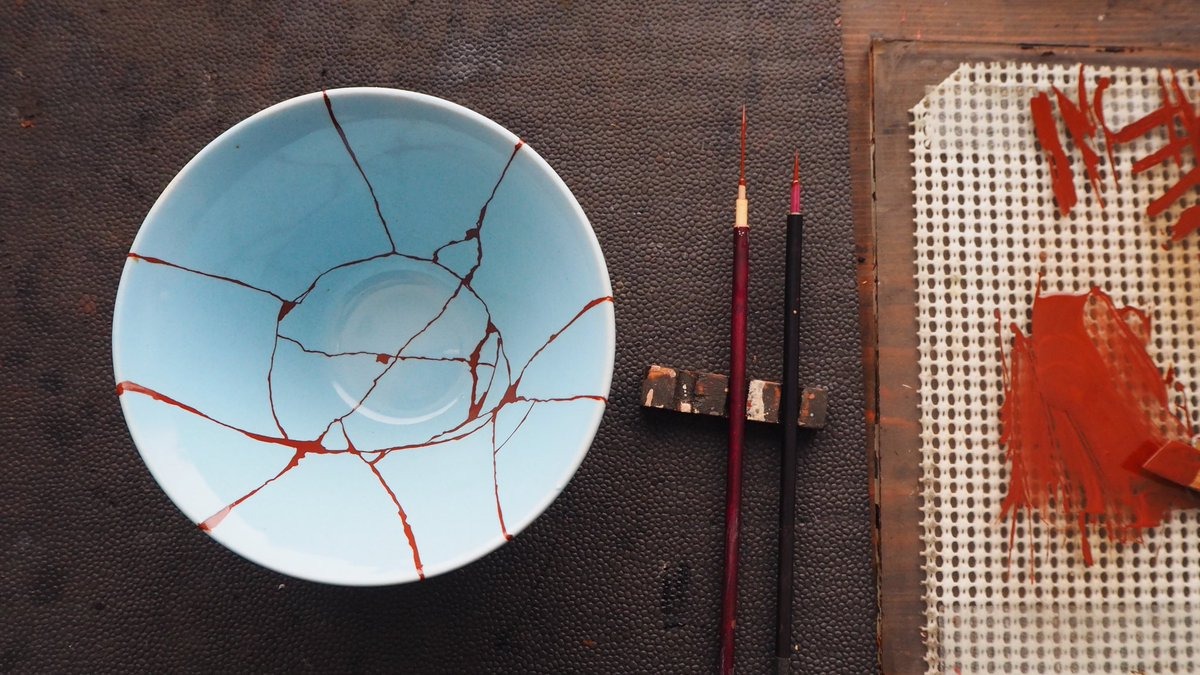
5. Gold powder grades
Frequently Asked Questions
Q: Does the finish colour affect food safety?
Q: Can I choose the finish colour when buying a piece?
Q: Will the gold tarnish the way silver does?
Q: Is one finish more durable than the others?